Showing posts with label bali. Show all posts

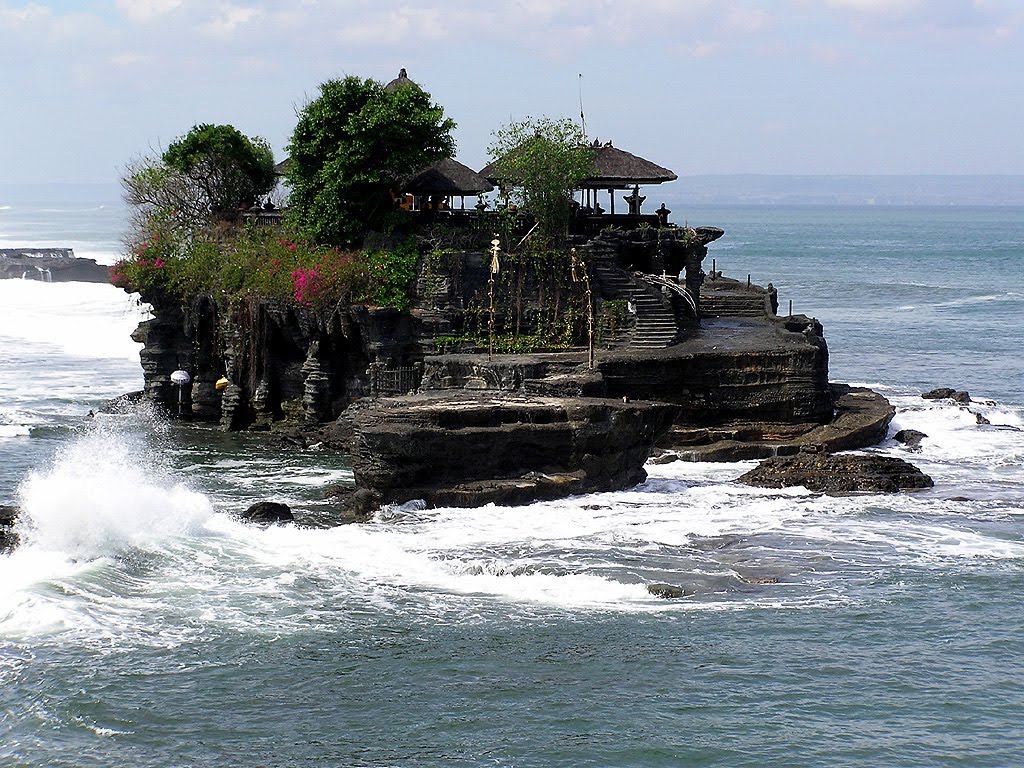
Tanah Lot, Bali

Tanah Lot tourist attraction is located in sub-province of Tabanan, precisely in countryside of Beraban, district of Kediri, sub-province of Tabanan.


Tanah Lot tourist attraction visited by one million of domestic and foreign tourist every year, so that Tanah Lot becoming one of the tourism icon in Bali. It is because of Tanah Lot have different characteristic. This small island looks floating when the sea level is high but when it is down, we can walk on the beach to the temple. The island has many caves that formed by the waves. and the caves are inhabited by sea snakes. Local people don't disturb these snakes because they belief that the snakes belong to the God in the temple.

Characteristics of Tanah Lot:
  1. Tanah Lot temple is near from the see when. For many reasons this is a very beautiful place to visit.
  2. There is a cave of holly snakes which is located in front of the temple. Local peoples believe that the snakes are guards of the temple
  3. The view of the sunset combine with Tanah Lot temple, is a very enjoyable atmosphere to watch.
  4. A requral ceremony held every six month, and many more ceremonies that held in the same week at Pakendungan temple.
  5. Tanah Lot is rocky beaches in effort of making nice wave.

Because of this beauty, many tourists domestic or international come to this place. But must be realized that the management of Tanah Lot, creativity and performance, need to be increased to develop Tanah Lot Area.


Apart from Tabanan ± 13 km
Apart from Denpasar is about ± 20 km
Wide : 202.830 m²
Circle : 2.509 m
North : Rice Field
East : Bali Nirvana Resort
South : Indian Ocean
West : Indian Ocean and River of Kutikan


(R) This blog contains various information about tourist destinations in Indonesia, from the very low-cost to expensive. hotel information, lodging, transportation, and accommodation support can also be found here.

Underwater Temples, Bali

Back when the world was younger, the ancient Sea Gods of Bali decreed that a temple should be erected in their honour at 30mtr depth (yes, even the Gods went metric). An thus it was Temple Garden was made for them all to play in.


Lighting incense is a bit of a bugger though so bring a torch instead.

 the ancient Sea Gods of Bali decreed that a temple should be  erected in their honour at  Underwater Temples, Bali
Lost city of Pemuteran?

 the ancient Sea Gods of Bali decreed that a temple should be  erected in their honour at  Underwater Temples, Bali
Ancient pose for happy divers....

 the ancient Sea Gods of Bali decreed that a temple should be  erected in their honour at  Underwater Temples, Bali
Diver checks watch to see what century she's in.

 the ancient Sea Gods of Bali decreed that a temple should be  erected in their honour at  Underwater Temples, Bali
ZOMBIE BUDDA!... Swim away, swim away.....

 the ancient Sea Gods of Bali decreed that a temple should be  erected in their honour at  Underwater Temples, Bali
Deeply Deco Spirits.

 the ancient Sea Gods of Bali decreed that a temple should be  erected in their honour at  Underwater Temples, Bali
Petrified sweetlipped turtle.

 the ancient Sea Gods of Bali decreed that a temple should be  erected in their honour at  Underwater Temples, BaliAnd finally a communion of spirits.

The facts:
Sank in 2005 as part of the still ongoing Reef Gardeners project. This little dive has become an interesting change from the reefs of Pemuteran. The often hazy vis creates a wonderfully spooky atmosphere.
Home to nudis and Electric clams, Temple Wall (or Pura Tembok) above also offers a lot of , well stuff to look at.
Personally I prefer the ancient gods story.

Bali - And They All Come Back Again

A total of 10 people have died during this year’s Idulfitri migration (in 6 days!!) on the island of Bali according to authorities.

In addition to the 10 fatalities, traffic accidents resulted in 10 serious injuries and 26 minor injuries. All casualties were traveling on motorbike. Most of the traffic accidents occurred in the “line of death” which is the route between Tabanan and Gilimanuk.
Police had been urging motorcycle travellers, especially mothers and their children, to use buses. Despite the fatalities, the situation has greatly improved from 2012 where 115 traffic accidents were recorded with 20 deaths, 57 seriously injured, and 127 minor injuries.


The Balinese Kris Or Keris

Although classified as a weapon, the Kris has a ceremonial function. The oldest ones come from the Buddha age, between the 6th and 7th centuries. There are approximately 20 periods, named according to the kingdoms that commissioned them, up to the present day. Each has their own distinctive markings. At the end of the 15th century the Majapahit kingdom was responsible for the spread of the Kris to Cambodia, Thailand, the Philippines and Malaysia.

Even today a real Balinese Kris is regarded as sacred and believed to possess sakti and have magical power called tuah. They are heirlooms. A man is not considered a real man unless he has a Kris. A Kris can increase bravery, help avoid illnesses and protect the owner from black magic and misfortune. They can be worth as much as US$100,000.

Bali's New Toll Road Soon Open

Bali’s toll road connecting Benoa Harbour, Ngurah Rai International Airport and Nusa Dua, is expected to be opened to the public at the end of August 2013.

This will happen after the regulatory agency, the Ministry of Public Works, has confirmed that the highway meets all technical requirements. The physical construction of the highway is complete. Now it is being checked to ensure it is up to specification. Hopefully, that process will finish at the end of August.

This inspection is essential. The road surface, signage, substations and patrol personnel must all be ready. The 12.7 kilometer long toll road will also accommodate motorcycles in a dedicated lane. The road, which passes over coastal waters for much of its length, is part of a package of infrastructure improvements designed initially to facilitate the Asia Pacific Economic Cooperation summit, which takes place in Nusa Dua in early October.

Source: Kompas

Bali - Great New Sababay Wines.

Last week I saw at the supermarket in Negara a merk new rose wine, Sababay.

In Bali there are not so much good rose types, only a lot of very expensive imported wines. So I take two bottles home, Rp 140,000. per bottle, and I must say it tastes excellent.

The rose is made from Alphonso grapes by the first French winemaker in Bali. Highly recommended.

Bali - Eco-Tourism

The Indonesian central government is planning to provide funds to turn 45 villages in Bali into Eco-tourism destinations.

In 2012, the government provided US$ 500,000 to 53 villages around the island for the same purpose, with the highest concentration in Bangli, Buleleng, Tabanan, Karangasem and Gianyar.

This year, the government has announced that it will be providing close to US$400,000 for 45 more. The aktivitas is very important and greatly benefits villages striving to become tourist destinations. It helps with planning, management and marketing. Local communities create proposals themselves, but, the provincial government will support them in every way.

For villages that have been earmarked as beneficiaries, the money means development of tourism facilities such as parking lots for buses, the installation of public toilets and the improvement of village roads. Workshops and pembinaan sessions are also provided to villagers to help them better understand tourists’ requests.

Bali - New Coral Reef Species Found

Bali has now been immortalized in the name of a new coral reef species found around Padangbai and Candidasa waters in Karangasem regency.

Euphyllia BALIensis species was discovered during a coral reef survey conducted by a group of scientists led by Lyndon Devantier. The survey was part of the Bali maritime quick review program.

The new coral reef species was discovered in 27 meters to 37 meters depth. It is a type of hard coral reef that has the endurance to survive along coastlines with strong ocean current. The Euphyllia Baliensis species can only be found in Bali. After a three months study, it has been confirmed to be a new species. It has unique characteristics. It looks like frangipani flowers. Because it is a strong hard coral, it secures the island well.

Compared to other species of the same euphyllidae genus, E. baliensis has relatively smaller corallites, with an average diameter of three milimeters, shown from its thinner and shorter branches, which are slightly calcified. The species has blunt red and brown tentacles, with a greenish cream base color.

The Bali maritime quick review aktivitas has also identified around 406 types of coral reef that live in the waters of Bali, including Nusa Penida. There are dozens more of coral reef species that require further taxonomy analysis.

Bali - Get Schapelle Corby An Early Release?

Schapelle Corby's chances of an early release from prison have been given a massive boost with corrections officers in Bali recommending her for parole.

The green light from the Bali corrections board (BAPAS) increases the likelihood that the convicted drug smuggler could soon be released from Kerobokan jail to live with her sister Mercedes in Bali.

Corby has shown good behaviour while in prison, that local society and officials could accept her and the family is ready with guarantee. She now has a chance to walk free on parole. The crucial recommendation will now be passed on to the Law and Human Rights Ministry before selesai approval, which could come within weeks.

Corby has been eligible to apply for parole since last August but her legal team had baulked at lodging an application after the Indonesian government introduced tough new conditions for prisoners convicted of serious crimes including drug trafficking. But the recommendation from BAPAS is a massive boost and all but clears the way for Corby to gain parole.

Corby would have to serve out the remainder of her sentence in Bali, which would see her remain on the island until mid-2015, so long as she continues to win the maximum eight months per year in remissions.

The recommendation from BAPAS, revealed today, comes after corrections officers visited the home of Mercedes Corby on Tuesday to assess whether it would be a suitable place for her to live. It's understood the officers also inspected documents related to Schapelle's parole, including an unprecedented guarantee letter from the Australian government. Corby, who was caught in 2004 attempting to smuggle more 4.1kg of marijuana into Bali, was sentenced to 20 years in jail but had her prison term slashed by five years by Indonesian President Susilo Bambang Yudhoyono.

Source: AAP

Bali - Yeh Sanih In Kubutambahan

View from the pool
When you visit Buleleng, a coastal regency in north Bali that is known as a hot zone, you should make the time to enjoy the Yeh Sanih springs, where you can swim in the cold water, fresh from a natural spring, while enjoying a beautiful beach view.

Yeh Sanih is fed by natural spring water and has become one of the favorite destinations in north Bali. It is located right by the sea in the village of Kubutambahan, around 30 minutes from Singaraja, the old capital of Bali and Nusa Tenggara during the Dutch colonial period.

The uniqueness of Yeh Sanih is its location near the beach. Despite being located by the sea, the pool there offers fresh, not salt, water. The spring is never dry, even in the dry seasons.The spring water is not only used for Yeh Sanih, but is also distributed to several villages around the area. As there is a huge amount of water produced naturally from the spring, the city tap water company distributes it to many houses around Buleleng.

There are two swimming pools in the 26 hectare plot of land at Yeh Sanih springs, one for adults and one for children. The adult pool is larger and is 1.5 meters deep. For children, there is a small pool that is only 0.5 meters deep. The pools are built of natural stone. The water is always clean, as it flows directly from the spring. The management from the Kubu Tambahan customary village also cleans the pool twice a week.

Balinese Hinduism: Agama Hindu Dharma

Foreign conquerors and visitors may come and go, but Bali’s culture remains.

For almost a thousand years, the native Balinese have followed a unique form of Hinduism, now known as Agama Hindu Dharma: a direct descendant of the religion brought to Bali by visiting Hindu gurus.

The rhythms of the Balinese religious calendar dictate island-wide days of obligation, temple-specific feast days, and daily personal rituals that connect every native Balinese to their families, communities, ancestors and gods. The religious needs of the populace ensures the preservation and continued popularity of thousands of temples and altars all around the island, ranging in size from simple family shrines to the “Mother Temple”, the Pura Besakih on Gunung Agung. And you’ll find their myths re-enacted in Balinese dances all over the island.

The strong link between the Balinese and their religion ensures that Bali retains a unique identity among Southeast Asia’s island destinations. Thanks in no small part to its unique culture, Bali has successfully resisted (to some degree) the commercialization and homogenization suffered by islands like Boracay in the Philippines or Phuket in Thailand. Balinese temples, dances, and ceremonies define the Bali tourist experience as much as its beaches or its surfing.

Bali - Retirement Visa, Kitas Or Kitap

As I had already written on my blog, if you are 55 or older (one partner may be younger), you can apply for a retirement visa, called Kitas. A Kitas is an annual residence permit, but you're not allowed to work in Indonesia and you need someone as a housekeeper, besides of course your own financial facilities and insurance. After 5 times a Kitas you can choose, or you continue with a Kitas or you can apply for a Kitap, as I have done now.

Continue a Kitas means you have to leave Indonesia, for example to the Indonesian Embassy in Singapore. A Kitap is a five-year residence permit, thus cost five times the price of a Kitas. A Kitas application currently costs 6 million rupiah, a kitap 30 million. When you apply for a Kitap you can just stay in Indonesia, you don't have to leave the country, and you don't have to go every year one or two times to the immigration office. Seen from a financial point of view, a kitap is too expensive, but you don't have to travel and less hassle.

The Kitap application takes about 4 months and you will need the following documents:
Original passport
Original Kitas
Original Blue Book
Original SKLD, police registration

Domicile letter from the village where you living
Proof of land/home ownership or rental agreement, in Bahasa Indonesian
For rent, copy KTP (identity card) from te landlord
Copy KTP housekeeper
Copies of income, bank statements, retirement letters, etc.
Copy health insurance
Copy liability insurance
Copy death insurance
Map of the area residential address

Bali - Tumpek Landep, Saturday, August 24

Around 150 kris, double-edged daggers, from across Indonesia will be displayed during a special parade to commemorate Tumpek Landep, a Balinese Hindu day dedicated to worship Sang Hyang Pasupati, the god of steel.

The ceremony will fall on Saturday, August 24, and will be commemorated by Balinese families cleaning all metallic instruments, especially family heirlooms such as swords, kris, spears and, nowadays, cars, motorcycles and other metal instruments.

During the annual parade held at Puputan Park in Denpasar, a number of artists and dancers from the Indonesian Arts Institute Denpasar will perform a special dance.
The theme of the event will be Taksu Keris Bali, Pusaka Budaya Nusantara (The Spiritual Power of Balinese Kris, the Nation’s Cultural Heritage). The launching of a new book entitled Jelajah Keris Bali (Exploring Balinese Kris), written by I WayanGriya, will be held also.

Secret Balinese Dances In Ubud

In a secret location well away from the bright lights of Ubud, a group of special guests were treated to the grand rehearsal of an event that will be seen by millions of viewers around the world in September.

Under the art direction of Indonesia’s most famous haute-couture designer, musician, philosopher and artist, Harry Darsono and director, Nyoman Budiartha, chairman of the conservatory and Tri Pusaka Cakti arts foundation, a series of Balinese ballet and musical performances underwent a few last tweaks ahead of opening in three world-class Bali events slated for September and October.

The troupe will perform during the inaugural international Lion’s Club ANZI Pacific Forum, followed soon after by performances during the first ever Miss World competition in Southeast Asia, to be held in Bali and Jakarta in late September, then a further performance for the opening of the APEC Summit in early October, probably attended again by Obama and Poetin.

As Indonesia’s foremost haute-couture designer, Darsono, who has crafted gowns for leading French fashion houses including Oscar de la Renta and Lanvin, has created the costumes and imagery for the production.
This extraordinary man, who has created gowns for Miss World contestants from Indonesia, England, Turkey, Norway, Wales and China, is clearly excited to be working with the Tri Pusaka Cakti troupe under the direction of Nyoman Budiartha.

Woj Nieuwenkamp, Dutch Painter In Bali (1874-1950)


WOJ Nieuwenkamp (born July 27, 1874, in Amsterdam in The Netherlands, died April 23, 1950, in San Domenico di Fiesole in Italy) was a Dutch painter, woodcarver, graphic artist, illustrator, art collector and a lot more. He was a globetrotter and the area he favoured mostly was Asia. His motto was in Latin ‘Vagando Acquiro’, ‘while wandering, I acquire (knowledge, ideas)’. The name of his houseboat was, not surprisingly, ‘De Zwerver’, ‘The Wanderer’. Between 1898 and 1937, he visited The Indies six times, which resulted in numerous drawings, etchings, prints, paintings and books, which he edited himself.

During his travels he made extensive notes and sketches in small and large booklets, which he worked out later in his artistic work and books. He gives us a picture of the way of living and thinking, of the rituals and the arts of the people in the countries that he visited. It differs from what an ethnologist, anthropologist, art historian or civil servant charged with a survey would write or report in the early 1900s, because he observed with the eyes and mind of an artist. The beauty of what he saw made a deep impression on him.

Nieuwenkamp is important for our knowledge of Bali at the beginning of the 20th century. He paid long visits to the island in 1904, 1906-7, 1917-19, 1935 and 1937. On April 4, 1904, during his first visit, he wrote: ‘there are so many beautiful things to see and to portray, which have not yet been noticed as beautiful, let alone discussed. Therefore I have decided to make a book with plates about Bali, the loveliest land I know’. This would become the album ‘Bali en Lombok’. The first part of it was published in the beginning of 1906.

He travelled by bike, by foot, on horseback; he stayed with Dutch civil servants, in pasanggrahans, in palaces, but also in a makeshift tent covering his camp bed. It appears that he was the first person in North Bali riding a bike. The people of Kubutambahan were so surprised, that they depicted Nieuwenkamp, with a mustache and a topee, on a relief of the Pura Madue Karang.
Wijnand Otto Jan Nieuwenkamp
Extensive preparations were made before embarking on his travels. He read about balinese culture, religion, history and literature, as much as what was available at that time. The Balinese drawings on paper commissioned by H.N. van der Tuuk between about 1880 and 1894, kept in the Leiden University Library, were studied so thoroughly that he was able to reproduce and draw them. His Balinese hosts were very much impressed by it. It is not impossible that this was the main reason why they treated him differently. During his first and second visit to Bali, Nieuwenkamp had contact with North Balinese artists who worked for Van der Tuuk, and bought drawings from them. This is important for my personal quest (Hinzler 1986-7) to find out more about these artists. When he visited the house of a woodcarver in Singaraja, he noticed a drawing of a ‘palm-wine tapper in a tree’ in the domestic sanctuary of the family. It resembled one of those from the Van der Tuuk Collection. It turned out that the drawing had been made by the carver’s father, I Ketoet Gede, who had worked for Van der Tuuk.

The second trip to Bali coincided partly with the Dutch military expedition to Badung and Tabanan in 1906. On July 6, he had permission to travel on board of one of the ships on their way to Bali, but he was not allowed to go ashore during the landing because of danger. He did not want to wait any longer, so he went by himself from Surabaya straight to North Bali by the end of July. In September, however, he met the Dutch in Denpasar. When he noticed that wooden parts of gamelan instruments were being used as firewood, both by the Dutch and the Balinese, he stopped them and rescued the beautifully carved pieces. In the Dutch newspaper ‘’Algemeen Handelsblad’’, he wrote articles about the destruction of the palaces and the killings (‘puputan’) in a very critical way. While walking around, he discovered the large bronze kettledrum, the ‘Moon of Pejeng’ in the Ubud region. He made sketches, drawings and rubbings of it, which he worked out later in the form of woodcarvings. In May 1925, he visited the Ubud region again. He was the first person to make drawings of the then recently (1922 or 1923) discovered rock carvings and sanctuary of Goa Gajah near Bedulu.

During his five travels to Bali, Nieuwenkamp ordered and bought drawings, objects, woodcarvings, doors, baskets and textile for museums and institutions in The Netherlands, as well as for his private collection. Because the origin, and in some cases the makers and artists, are named, and also because the process of manufacture is well documented in his diaries as well as books and articles based on them, the collection is very important.

Nieuwenkamp’s work is of great importance for North Bali. He made sketches, and produced woodcarvings, etchings, and a few paintings of temples, gateways, views, ships, people, textile and dancers. So far, a great number of them have only been reproduced in his books and articles which, by the way, were only published in Dutch. It was only in 1998 that an English edition appeared about the ‘First European Artist in Bali’, with reproductions of a selection of 321 drawings made during his whole career, 197 of which are pertaining to Bali. No separate issue exists yet on his work done in North Bali.

H.I.R.Hinzler, Leiden, March 2009
Bibliography:
Carpenter, B., W.O.J. Nieuwenkamp, First European Artist in Bali, Uniepers, Abcoude, 1997.
Nieuwenkamp, W.O.J., Bali en Lombok, album 1, beginning 1906; album 2, January 1909; albums 1,2,3, Elsevier, Amsterdam, 1910.
Nieuwenkamp,W.O.J. Zwerftochten op Bali, Elsevier, Amsterdam, 1910.
Nieuwenkamp, W.O.J., Zwerftochten op Bali, Elsevier, Amsterdam, 1922.
Nieuwenkamp, W.O.J., De Olifantsgrot bij Bedoeloe op Bali, Nederlandsch Indie Oud en Nieuw, No. 10, 1925: 333-341.
Nieuwenkamp, W.O.J., Bouwkunst van Bali, H.P. Leopolds, Den Haag, 1926.
Nieuwenkamp, W.O.J., Beeldhouwkunst van Bali, H.P. Leopolds, Den Haag, 1928.
Nieuwenkamp, Boukunst en Beeldhouwkunst van Bali, H.P. Leopolds, Den Haag, 1947.
Nieuwenkamp, W.O.J. (grandson), Leven & Werken, Bouwen & Zwerven van de kunstenaar W.O.J. Nieuwenkamp, opgetekend door zijn kleinzoon, A.W. Bruna & Zoon, Utrecht, 1979.
Bali - Budakeling, Eco-Tourism Village

Budakeling, one of the villages designed with a community-based tourism concept, is ready to welcome more guests after completing the renovation of some houses. A total of 21 rooms in tourist-standard home-stays were now available.

Open for tourists since 2010, the village, located in Karangasem regency, has seen a growing number of European visitors, mostly from France and Switzerland. There are also some tourists from Japan and Korea. In the first year, it welcomed 16 people. This rose to 36 people in 2011 and 37 people last year. As of mid this year, 19 tourists had made reservations to stay in the village.

Tourists are usually interested in finding out about the daily life of the local people and interacting with them. Almost every day, groups of tourists are brought by hotels or travel agents to visit the village for a short trip. The tourists usually buy silver and gold handicrafts made by local residents.

Budakeling village is situated on a hill between Tirtagangga water palace and Bebandem in Karangasem regency. Overlooking the east coast of Bali, with Mount Agung in the background, it is well known among the Balinese for its high priests. For tourists, it is a village of farmers, artists and craftsmen – from dancers and painters, to stone sculptors and engravers of Sanskrit lontar manuscripts.

The village offers an interesting holiday package. As guests arrive in the village, they are welcomed with traditional snacks and beverages. The next morning, at around 6 a.m., guests are offered a visit to the traditional market to buy meat and vegetables for their lunch and dinner that they will then cook together with the locals. After going to the market, guests return to the homestay to have breakfast with the owner. They spend the entire day around the village enjoying the panoramic views and cool weather, while watching villagers going about their activities in the rice fields, schools, village administration office and in craft workshops.

Budakeling is one of seven villages developed under the concept of community-based tourism, in which tourism is managed by the villagers. The other six villages are Penglipuran, Bedulu, Jasri, Blimbingsari, Pancasari and Pinge.

By visiting the villages, travelers get the rare opportunity of first-hand experience with local communities. They spend quality time in areas rich in culture and biodiversity, and immerse themselves in the day-to-day lives of local, indigenous villagers. Under this scheme, villagers earn income as accommodation managers, entrepreneurs, tour guides or in other related occupations. In addition, a portion of the generated revenue is set aside for projects benefiting the community as a whole.

Bali - The Apec Summit In October

Fourteen of the 21 APEC economies leaders have already confirmed their attendance for the annual summit that will take place in Nusa Dua early October.

Among those scheduled to attend the APEC leaders meeting on Oct. 7 and 8 are President Susilo Bambang Yudhoyono, US President Barack Obama, Russian President Vladimir Putin and Chinese President Xi Jinping.

The event organizing committee is still waiting for confirmation from the heads of APEC states: Australia, Brunei Darussalam, Canada, Hong Kong, Papua New Guinea, Taiwan and Vietnam.
Some confirmed are: Philippine President Benigno Aquino, Mexican President Enrique Pena Nieto, Korean President Park Geun-hye, Chilean President Sebastian Pinera, New Zealand Prime Minister John Key, Singaporean Prime Minister Lee Hsien Loong, and Malaysian Prime Minister Najib Razak.

The CEO Summit will feature a jadwal covering the key issues affecting the region.
The summit’s theme “Towards Resilience and Growth: Reshaping Priorities for Global Economy” is expected to provide a discussion lembaga for policy makers, business leaders and innovative thinkers on securing inclusive sustainable growth and achieving the aim of shared development and common prosperity for all. Among the thought leaders scheduled to attend are Nobel Laureate Aung San Suu Kyi, Nouriel Roubini of Roubini Global Economics and Kishore Mahbubani of the Lee Kuan Yew School of Public Policy.

The APEC Summit will start with the Senior Officials Meeting on Oct. 1 and 2, followed by the Ministerial Meeting on Oct. 4 and 5, the CEO Summit on Oct. 6 and 7 and conclude with the Leaders Summit on Oct. 7 and 8. All meetings during the APEC Summit will take place in the Nusa Dua resort complex.
In addition to the 21 heads of state and 46 ministers, the summit is expected to be attended by 5,250 economic leaders and around 3,000 journalists from across the globe. There are also around 182 preliminary meetings held ahead of the summit, attended by around 100,000 delegates.
To support this event, several infrastructure projects have been conducted in Bali. Among these is the Dewa Ruci underpass that cost around Rp 148 billion, the Rp 2.8 trillion expansion of Ngurah Rai International Airport and the construction of the Benoa–Ngurah Rai–Nusa Dua toll road, which cost Rp 2.5 trillion.

Bali - Pura Negara Gambur Anglayang

Pura Negara Gambur Anglayang in Kubutambahan village, Buleleng regency is a rare and unique temple.

Established in the 13th century, when the village was an ancient trade port named Kuta Baning, Pura Negara Gambur Anglayang is a place of worship for people of different faiths.

The temple has eight pelinggih (worship shrines) dedicated to different faith followers. There is a pelinggih named Ratu Bagus Sundawan for worshipers from Sunda (now in West Java). Another pelinggih is named Ratu Bagus Melayu, dedicated for worshipers from Malaya (Sumatra, Singapore and Malaysia). Yet other pelinggih are Ratu Ayu Syahbandar and Ratu Manik Mas as representations for Chinese and Buddhist followers. Ratu Pasek Pelinggih, Dewi Sri and Gede Siwa are for Hindu devotees. At the entrance gate is Ratu Dalem Mekah, representing traders from Gujarat in India.

The architectural design of the temple is similar to other temples in Bali. What makes it different is its pelinggih and interior ornaments. There is also a wall painting depicting a gold vessel sailing on the ocean. The painting records the journey of Ratu Ayu Syahbandar from China to Kubutambahan village.

During the odalan (temple anniversary), which falls every Buda Wage Kelawu (a day in the Balinese calendar that occurs every six months), thousands of local residents and people from numerous places come to pray at the temple. At the start of the anniversary rituals, there is a ritual at the beach to welcome the deities who will reside in the eight worship shrines during the celebrations. The worshippers also strongly believe they will spiritually see a gold ship passing by the sea near the temple.

Despite being unknown to many visitors, the temple is a genuine example of religious tolerance in Bali, the concept practiced by local residents and visitors alike for hundreds of years.

Bali - Batur Pameran From 20-22 September

The Ministry of Tourism, together with Bangli administration, will jointly organize and hold the Batur Festival in Kedisan village from Sept. 20 through 22, as part of their effort to widely introduce and promote Batur as one of UNESCO’s geoparks.

The coming ekspo has several objectives, to introduce the concept of the geopark to local people and visitors alike, and to attract global visitors, scholars in particular, to explore Batur’s geopark potential.

The organizing committee plans to provide shuttle buses and vehicles to transport visitors to the ekspo site. The shuttle buses will be parked at Central Parkir Kuta close to Jl. Sunset Road and Jl. Legian Raya, Ubud traditional market in Ubud and Batur Volcano Museum. During the three-day festival, visitors will be able to watch numerous art and cultural performances from Bangli regency, including bondres comedy, joged traditional dance and the Calonarang drama. Exhibitions promoting handicrafts and local arts will also feature.

Bangli regency has received Rp 31 billion in funding for the improvement of infrastructure and to support the operation of the museum. The regency also obtained Rp 2 billion from the Tourism Ministry to manage tourism facilities in Batur and the surrounding areas.
Since it was designated as a geopark, the number of visitors to Batur had increased from 300,000 persons in 2011 to 500,000 persons in 2012. It is expected around 750,000 persons will visit Batur during 2013.